Tabletop terrain generator: dungeon tiles, walls and scatter
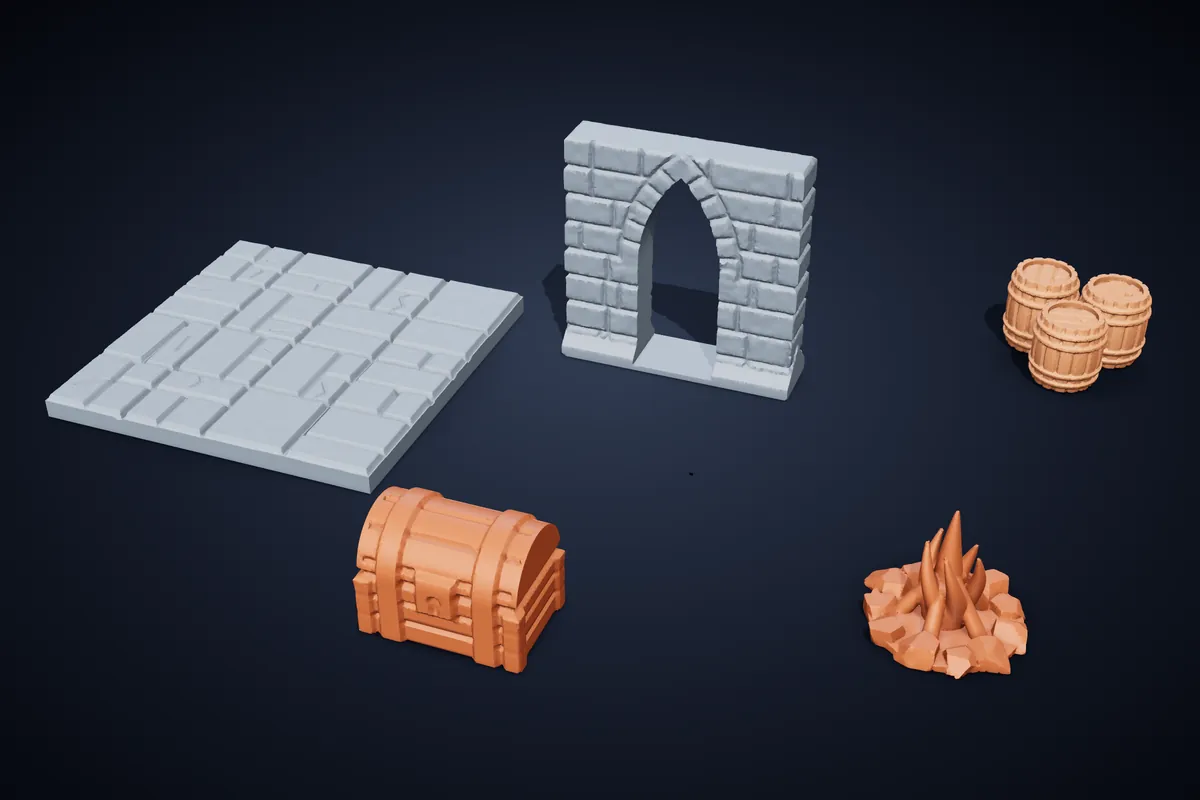
Floor tiles, stone walls and props for 28–32 mm games, laid out on a 1-inch grid so every square matches your battle map. Change the size, the grid and the magnets, and every piece still prints flat or upright with no supports.
How it works
- 1
Pick a piece
25 ready-made starting points in the library: 7 floor tiles, 7 wall pieces and 11 scatter props, from a 1×4 corridor to a stone well.
- 2
Fit it to your table
Tiles run from 1 to 4 squares each way on a 1-inch (25.4 mm), 25 mm or 28 mm grid. Walls run 1 to 4 squares long and 1 to 3 storeys high; props scale from 60% to 200%.
- 3
Add magnets and variation
Choose 5 × 2, 6 × 2 or 6 × 3 mm magnet pockets under the tile, under every square or along the edges. The variation number lays the stones out differently, so no 2 tiles look the same.
- 4
Download and print
Each piece exports as a print-checked STL. Tiles print flat on the bed, walls and props print upright, and none of them need supports.
The 25 terrain pieces
Every entry is a set of starting numbers for 1 of 3 shapes — a floor tile, a wall or a scatter prop — so each one adjusts as far as the others.
- Dungeon floor tile 2×2
- Flagstone floor, 2 × 2 squares (50.8 mm) with grid lines cut into the joints, 5 mm thick.
- Dungeon corridor tile 1×4
- A 1-square-wide flagstone corridor, 25.4 × 101.6 mm.
- Dungeon room tile 4×4 — magnetic
- A 101.6 mm flagstone room with a bridged 6 × 3 mm magnet pocket under every square, for a steel base board.
- Cobblestone street tile 2×2
- Rounded cobbles with grid lines for town streets and courtyards.
- Wooden plank floor tile 2×2
- Staggered boards with grain, knots and nail heads for a tavern or a ship.
- Cave floor tile 3×3
- Rough, fractured rock, 76.2 mm square, with 6 × 2 mm magnet pockets along the edges to join neighbouring tiles.
- Grass and dirt tile 2×2
- Grass tufts, bare dirt patches and pebbles for outdoor battles.
- Dungeon wall 2 squares
- Stone-brick wall, 50.8 mm high and 10 mm thick on a chamfered footing, mortar joints on both faces.
- Dungeon wall with doorway
- An open pointed-arch doorway wide enough for a 25 mm base, with voussoirs round the arch.
- Dungeon wall with plank door
- A 1-square wall with a closed plank door set in a pointed arch.
- Dungeon wall with windows
- A 2-square wall with a pointed-arch window over each square.
- Ruined wall
- Broken off block by block, with fallen stones at its foot.
- Dungeon wall corner
- An L-shaped piece that joins 2 straight walls on a grid corner.
- Dungeon pillar
- A square stone pillar with a footing and capital, 1 storey high.
- Stack of crates
- 3 braced plank crates in 1 piece, 30 × 15 mm footprint, 27 mm tall.
- Barrels — group of three
- 3 barrels with stave joints and iron hoops, joined at the hoops, about 33 × 31 mm and 19 mm tall.
- Treasure chest
- Barrel lid, iron straps and a keyhole lock plate, about 21 × 14 mm and 15.5 mm tall — a loot marker.
- Stone well
- Stone well with a winch beam, crank, rope and bucket, 26 mm across and 31 mm tall.
- Rock cluster
- 5 faceted boulders about 23 mm across, as scatter or difficult terrain.
- Low-poly pine tree
- A faceted pine in 4 tiers on a 22 mm base, 38 mm tall.
- Wooden fence
- A 2-square (50.8 mm) post-and-rail fence on a grassy strip, 15 mm tall.
- Gravestone — RIP
- A weathered, cracked headstone on a plinth with a grave mound, 20 mm tall.
- Campfire
- A ring of stones, a teepee of logs and 6 flame tongues, 22 mm across and 17 mm tall.
- Broken column
- A fluted column snapped off at about 30 mm, with fallen fragments around it.
- Stone stairs
- 8 stone steps, 1 square wide and 2 deep, rising 1 storey (50.8 mm).
Built on the grid your figures stand on
A square is 1 inch (25.4 mm) by default, the size of most battle maps and of a standard 25 mm base. If your table uses 25 mm or 28 mm squares, switch the grid and tiles, walls and props all follow it.
Walls stand on a tile edge and default to a 50.8 mm (2 in) storey, which suits 28–32 mm figures; you can set it anywhere from 30 to 76.2 mm and stack up to 3 storeys. The stone courses are set from the storey height, so walls of the same height match from piece to piece.
- Surfaces
- Flagstone dungeon, cobblestone, wooden planks, rough cave rock, or grass and dirt.
- Tile thickness
- 3 to 10 mm, 5 mm by default, raised automatically to fit the magnets under the texture.
- Wall pieces
- Plain, pointed-arch doorway (open or with a plank door), pointed-arch window, ruined, corner or pillar; 6 to 16 mm thick.
- Props
- Crates and barrels from 1 to 3, a pine or broadleaf tree, 3 headstone styles with an optional lean, an intact or broken column, a 1 to 3 square fence and 3 to 12 stairs.
Print settings for a 0.4 mm nozzle
Detail is sized for a 0.4 mm nozzle in PLA: stone joints are 1.4–1.8 mm wide and 0.6–1 mm deep, cracks and wood grain 0.7 mm wide, so they come out crisp rather than filled in. Print floor tiles flat, exactly as they come; every top face looks up, however rough the texture.
Walls and props print upright. Mortar joints on their faces are V-grooves with 45° flanks, and every arch is pointed, its 2 arcs meeting no more than 46° from vertical, so doorways and windows print open with nothing underneath. Magnet pockets are 0.2 mm over size; glue the magnets in once the tile is off the bed.
Questions
Will the tiles match my battle map and my miniatures?
Yes. The default grid is 1 inch (25.4 mm), the usual battle-map square, and the doorway is wide enough for a 25 mm base. You can switch to a 25 mm or 28 mm grid if your table uses one.
Do any of the pieces need supports?
No. Tiles print flat, walls and props print upright, and the grooves, arches, magnet pockets and fence rails are all shaped to print without supports.
Which magnets fit the tiles?
Round magnets of 5 × 2, 6 × 2 or 6 × 3 mm. The pockets are 0.2 mm over size so a magnet drops in and can be glued flush. Put them under every square for a steel base board, or along the edges to join tiles to each other.
Can I print the terrain in several colours?
Each piece is 1 solid part, so it prints in a single filament, ready to paint by hand once it is printed.
Can I sell the terrain I print?
Printed items are covered by the commercial licence from the Pro plan upward, and the library is in the Ultra plan. The digital files themselves may not be redistributed.
Which plan includes the terrain?
It is part of the parametric object library in the Ultra plan, which also includes everything in Pro.
Related
Try it now
Ultra includes this mode. Cookie cutters stay free.