Articulated dragon and flexi creature generator
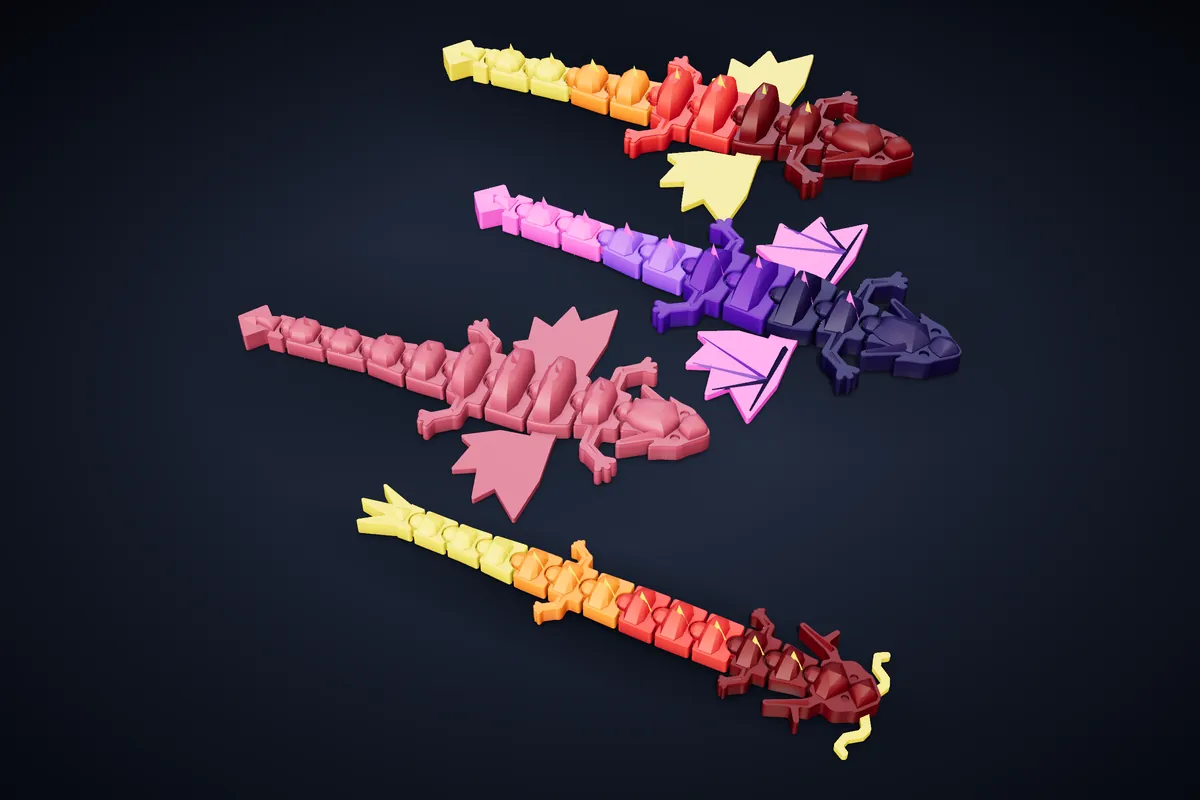
The wiggly dragons from every craft-market table, made to your size, finish and colours. They come off the bed already moving — pinned hinges, no supports, nothing to assemble — and a multi-colour one opens in the slicer already painted.
How it works
- 1
Pick a creature
Dragon, serpent dragon, gecko, snake, axolotl, shark, crocodile, T-rex, fish, caterpillar or octopus — 11 creatures, with 39 ready-made starting points in the library.
- 2
Choose the finish
Soft for a smooth, rounded toy; crystal for sharp gem facets and pyramid spikes; 3D sculpted for a rounded back on every segment. All three print without supports.
- 3
Set size and colours
Length from 80 to 240 mm, 2 to 16 segments, and one colour or one of 12 schemes — galaxy, dragon fire, aurora, ice, pastel, koi stripes and more — split into as many filaments as your printer has.
- 4
Download and print
STL for one colour. For several, the 3MF keeps every segment as its own coloured part, so Bambu Studio or OrcaSlicer opens it ready to assign AMS slots.
How the hinges work
Every joint is the same three-layer hinge: the part in front owns a fork of two plates joined by a pin, the part behind owns a tongue in the middle layer with a hole round the pin. The clearance separates them in every direction, so the slicer prints them as captured islands rather than one fused lump.
Each segment stops short of its neighbour, so it swings about 20° either way. Legs, fins and wings lie flat on the bed and stay out of the neighbours' reach, which is why the creature moves the moment it comes off the plate.
- Hinge clearance
- 0.3 to 0.8 mm; 0.4–0.5 mm suits a tuned printer. More if the joints fuse.
- Pin diameter
- 2.4 to 5 mm — thicker pins survive rougher play.
- Thickness
- 6 to 14 mm for the hinge layer; the 3D finish adds its rounded back on top.
- Keyring loop
- An optional loop on the tail for a split ring or a bag clip.
Multi-colour without painting
The trend on every maker table is colour that runs down the body: dark at the head, bright at the tail. Here each segment is its own part, so a colour scheme is simply which filament each part gets — no painting in the slicer, no colour changes by hand.
Gradients are split into as many bands as you have filaments, 4 by default for one AMS; spikes, fins and wings take an accent that is always one of those colours, so the count never grows. Striped schemes such as koi and bumble bee alternate segment by segment.
Printing tips
Print flat, exactly as the model is laid out, with no supports and no brim touching the joints. A clean first layer matters most: if elephant's foot squashes the bottom plates together, the hinges stick, so level carefully or raise the clearance.
Snap each joint gently once it is cool and it moves freely from then on. Silk and dual-colour silk filaments make striking single-filament dragons; for the gradients, matte or basic PLA keeps the colour bands crisp.
Questions
Do the dragons really print in one piece, already moving?
Yes. Every hinge is modelled with its clearance, and our checks prove each object is a set of closed solids, that no part floats in the air and that nothing needs supports.
How many colours do I need?
One is enough — every creature works as a single-colour print. The colour schemes use as many filaments as you set, from 2 to 8; 4 fits one AMS.
What is the difference between crystal and 3D sculpted?
Crystal cuts every segment into sharp gem facets with pyramid spikes. 3D sculpted gives every segment a smooth, rounded back, so the creature looks full-bodied rather than flat.
Can I sell the dragons I print?
Printed items are covered by the commercial licence from the Pro plan upward, and the library is in the Ultra plan. The digital files themselves may not be redistributed.
Which plan includes the flexi creatures?
They are part of the parametric object library in the Ultra plan, which also includes everything in Pro.
Related
Try it now
Ultra includes this mode. Cookie cutters stay free.