Ring STL generator in your exact size
Rings sized to the standard US, EU, UK or Japanese tables, or to an inner diameter in millimetres, plus spinner rings, name rings, pendants and earrings. Every ring prints upright with no supports, and the inside stays exactly the size you chose.
How it works
- 1
Pick a model
Start from one of 25 ready-made pieces: 9 patterned bands, 2 name rings, 2 spinner rings, 2 signet rings, 7 pendants and 3 pairs of earrings.
- 2
Set the size
Choose the size system — US / Canada, EU / ISO, UK / Australia letters, Japan / Korea or inner diameter in mm — and the size. US runs from 3 to 15 in quarter sizes; a fit allowance from -0.3 to +0.8 mm loosens or tightens it.
- 3
Adjust the style
Band width, thickness, profile (comfort fit, D-shape or flat) and pattern, or the letters on a name ring, the motif on a signet ring and the size and bail hole of a pendant. The preview rebuilds as you go.
- 4
Download and print
Export the STL or 3MF after the print check and print it on a 0.4 mm nozzle: rings standing upright, pendants and earrings flat on the bed.
The 25 models
Each entry is a starting point, not a fixed file: every ring can be resized and restyled, and every pendant can take a different design, size and bail.
- Ring — plain comfort-fit band
- A 6 mm plain band with a domed comfort-fit inside, default US 7 (17.3 mm).
- Stacking ring — thin band
- A slim 3 mm D-shape band for stacking, default US 6 (16.5 mm).
- Wide flat band ring — men’s
- An 8 mm flat band with eased edges, default EU 64 (20.4 mm).
- Twisted ring
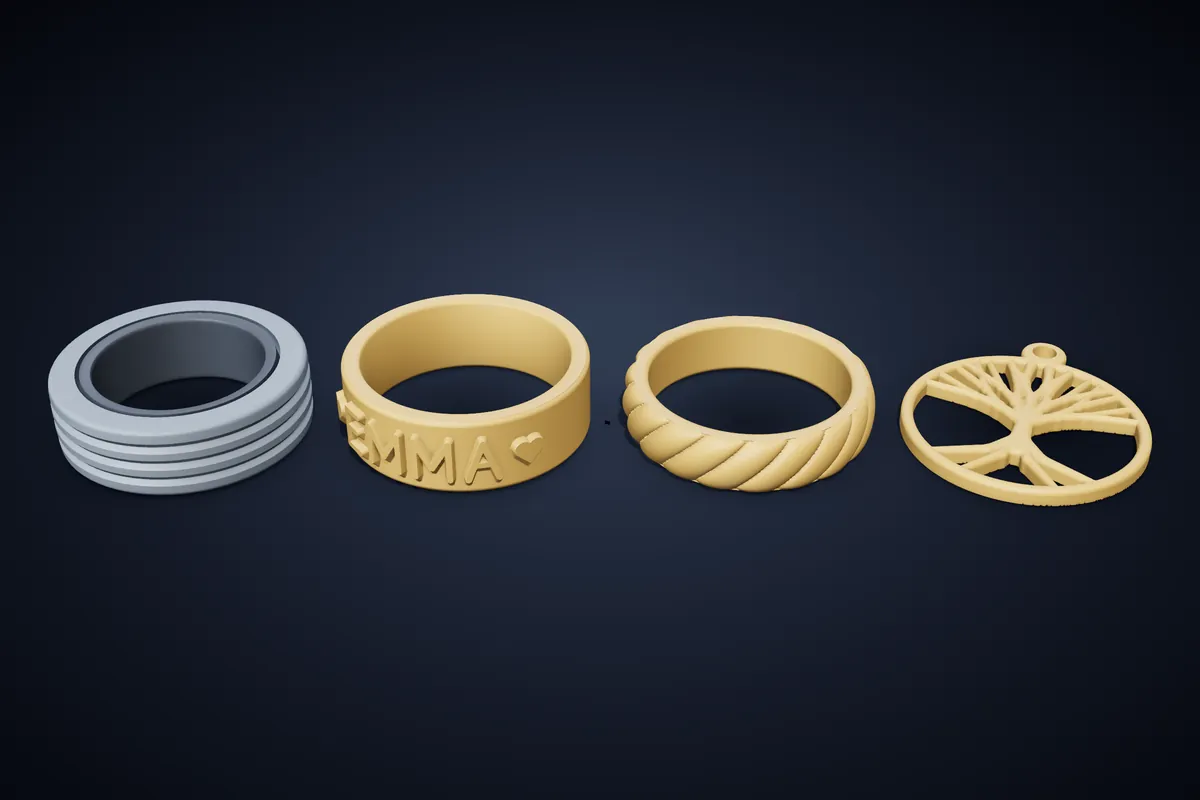
- A band of bold twisted strands, 5 mm wide, default US 7.
- Braided ring
- Staggered chevron strands either side of a centre seam, 6 mm wide, default US 7.
- Knurled ring — men’s
- A 7 mm band with a diamond-knurled middle between smooth rims, default US 10 (19.8 mm).
- Hammered ring
- Hammered-metal dimples, 6 mm wide, default US 8 (18.1 mm); “Variation” changes the hammer pattern.
- Hearts ring
- A 6 mm band with a row of engraved hearts all the way round, default US 6.
- Low-poly faceted ring
- Flat triangular facets outside, a smooth comfort-fit inside, default US 8.
- Name ring
- A 7 mm band with up to 10 letters, numbers or symbols in raised block capitals and a heart either side; default “EMMA”, US 7.
- Word ring — LOVE
- A 6 mm band with LOVE engraved between 2 small stars; swap in another word, initials or a date.
- Spinner ring — fidget / anxiety ring
- A grooved outer band that turns freely on the inner band, printed in place, 8 mm wide, default US 8.
- Spinner ring — knurled
- A diamond-knurled spinner for grip, 9 mm wide, default US 10, printed as one piece.
- Signet ring — heart
- An oval flat face with an engraved heart, default US 6 (16.5 mm).
- Signet ring — compass
- A cushion face with an engraved compass rose, default US 10 (19.8 mm).
- Heart pendant
- A 28 mm puffy heart with a bail loop that takes chains up to 3.5 mm.
- Crescent moon pendant
- A 30 mm gently domed crescent moon with a bail loop.
- Star pendant
- A 30 mm 5-point star with bevelled facets rising to a centre point.
- Geometric hexagon pendant
- An open hexagon frame with the 3 inner edges of a cube, 30 mm across.
- Leaf pendant
- A 34 mm leaf with an engraved midrib and veins and a short stem.
- Tree of life pendant
- An openwork tree, branches and roots joined to a 34 mm round frame.
- Sun pendant
- A 32 mm sun with 12 long and short rays and a domed centre ringed by an engraved line.
- Geometric drop earrings
- A pair of 40 mm open diamond drops with a 1.8 mm jump-ring hole.
- Hoop drop earrings
- A pair of 30 mm flat hoops, each with a small eye for a jump ring.
- Leaf earrings
- A mirrored pair of 42 mm openwork leaves with a jump-ring hole at the stem.
Sizes that match the jeweller’s tables
A ring that is half a size out is a ring nobody wears, so the size is the one number the generator never moves. US / Canada sizes step 0.8128 mm of inner diameter, so US 7 is 17.3 mm. EU sizes are the inner circumference in mm (ISO 8653), UK and Australian letters follow BS 6820 with half sizes, and Japanese and Korean sizes start at 13.0 mm and add 1/3 mm per size. If you already know the inner diameter, enter it directly, from 12 to 26 mm.
Patterns, engravings and raised letters are only ever added to the outside. The finger side keeps its exact diameter, and the fit allowance is the only thing that changes it.
- Band width
- 2 to 14 mm on plain and patterned bands, 6 to 12 mm on spinner and signet rings, 4 to 12 mm on name rings.
- Thickness
- 1.4 to 3.5 mm on bands, 1.6 to 3 mm on name rings.
- Profile
- Comfort fit (domed inside), D-shape or flat.
- Patterns
- Plain, twisted, rope, braided, knurled, hammered, hearts, stars, wave, grooves and low-poly facets.
Printing tips for a 0.4 mm nozzle
Rings print upright, the band standing on the bed, so each layer is a closed loop and nothing hangs in the air. Every surface is kept within 42° of vertical: engravings get a chamfered ceiling, raised letters a short ramp beneath and the bottom edge a chamfer, so no supports are needed anywhere. Pendants and earrings print flat.
Bands wider than 6 mm fit snugger on the finger, so add 0.1–0.2 mm of fit allowance for them, or if your prints come out tight. PLA is fine for trying sizes and for everyday wear; print a cheap test band first and check it on the finger before the final colour.
- Spinner clearance
- 0.4 to 0.7 mm between the bands, 0.45 mm by default; raise it if the spinner fuses.
- Capture lip
- 0.9 to 1.6 mm: how far the inner band’s rib reaches under the spinner, always at least 0.5 mm past the spinner’s bore.
- First layer
- The bottom 0.3 mm of the spinner gap is chamfered open to about twice the clearance, so a squashed first layer does not weld the bands together.
- Pendant bail
- Bail hole from 2.5 to 6 mm to fit your chain or jump ring; pendant size 18 to 50 mm, thickness 1.8 to 4 mm.
- Earrings
- Drop length 18 to 60 mm, jump-ring hole 1.4 to 3 mm; add jump rings and standard ear hooks.
Questions
How do I know which size to choose?
Use the size from a ring that already fits — US, EU, UK or Japanese — or measure the inside diameter of that ring and enter it in millimetres. The inside of the printed ring is made to exactly that size; add 0.1–0.2 mm of fit allowance for bands wider than 6 mm or if your prints come out tight.
Does the spinner ring really spin straight off the printer?
Yes. The outer band is printed in place over a rib on the inner band with a clearance gap all round, so the 2 bands are separate solids that cannot come apart. If they fuse on your printer, raise the clearance from 0.45 mm towards 0.7 mm.
Do the rings need supports?
No. Rings print upright with every surface kept within 42° of vertical, and pendants and earrings print flat on the bed.
Can I put my own name or date on a ring?
Yes. The name ring spells up to 10 letters, numbers or symbols in raised or engraved block capitals, with hearts, stars, dots or nothing either side. There are also preset words such as LOVE, MOM, DAD, HOPE and BFF.
Can I sell the rings I print?
Printed items are covered by the commercial licence from the Pro plan upward, and the library is in the Ultra plan. The digital files themselves may not be redistributed.
Which plan includes the rings and jewellery?
They are part of the parametric object library in the Ultra plan, which also includes everything in Pro.
Related
Try it now
Ultra includes this mode. Cookie cutters stay free.