Robot STL generator: flexi robots and robot figures
Articulated robots that come off the bed already moving, and sculpted desk-toy robots that stand upright, all made to your height. Print them in one colour, or download a 3MF that opens in the slicer already painted.
How it works
- 1
Pick a robot
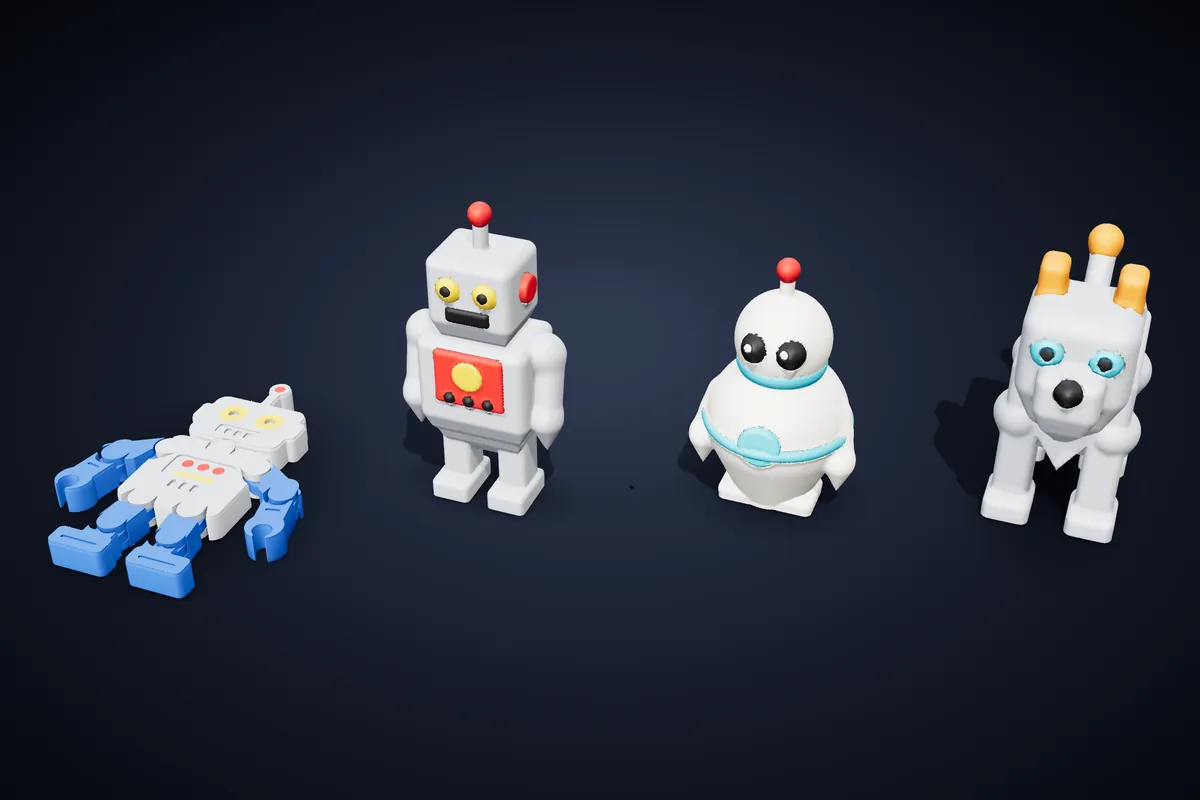
17 ready-made starting points: 11 sculpted figures — retro tin toy, round bubble bot, boxy desk buddy, robot dog, tank-tread robot and tall android — and 6 print-in-place flexi robots in classic boxy, round retro and angular mech styles.
- 2
Set size and joints
Figures from 50 to 180 mm tall, smooth or low poly. Flexi robots from 90 to 200 mm, 10 to 16 mm thick, with full joints (neck, shoulders, elbows, hips, knees) or simple ones (neck, shoulders, hips) and an optional keyring hole.
- 3
Choose the colours
One colour, two-tone body and limbs on the flexi robots, or painted in up to 4 filaments with inlaid eyes, buttons and lights.
- 4
Download and print
STL for one colour. For several, the 3MF opens in Bambu Studio or OrcaSlicer with every part already assigned, ready for AMS slots.
The 17 robots
Every entry is a set of starting numbers, so a mini robot and a shelf-sized one are the same model at a different height.
- Retro tin-toy robot
- A wind-up-style robot with a dial chest panel, round eyes and a ball antenna, 100 mm, painted in 4 colours.
- Retro tin-toy robot — large
- The tin-toy robot at 140 mm for a shelf, painted in 4 colours.
- Mini robot figure
- A 50 mm tin-toy robot for desks and gift boxes, in 1 colour.
- Round bubble robot
- A dome head, big eyes and a light-up belt, 80 mm, the round body on a tapered base, painted in 4 colours.
- Desk buddy robot
- A boxy robot with a big screen face, smile and thick antenna, 90 mm, painted in 4 colours.
- Desk buddy robot — large
- The desk buddy at 150 mm for a shelf or monitor stand, in 1 colour.
- Robot dog
- A blocky robot puppy with square ears, a ball-tipped tail and a back panel, 70 mm, painted in 4 colours.
- Robot dog — large
- 110 mm tall, about 120 mm nose to tail, on 4 solid legs over a pointed-arch belly, in 1 colour.
- Tank-tread robot
- Caterpillar tracks, binocular eyes and arms resting on the treads, 90 mm, painted in 4 colours.
- Humanoid robot (android)
- A tall humanoid with a visor helmet and jointed limbs, 150 mm, painted in 3 colours.
- Tank-tread robot — large
- The caterpillar-track robot at 130 mm in 1 colour.
- Flexi robot — print-in-place
- Neck, shoulders, elbows, hips and knees move on captive pin joints with 0.45 mm clearance, 130 mm tall.
- Flexi robot — multi-colour
- A silver body, blue limbs and inlaid eyes and buttons, set up for 4 filaments, 130 mm.
- Flexi robot — round retro
- A round head with a heart window, a smile and 10 moving parts, set up for 4 filaments, 130 mm.
- Flexi mech robot
- An angular mech with an inlaid visor and power core and chest vents, 2 colours, 150 mm tall and 13 mm thick.
- Flexi robot keychain
- A moving head, arms and legs and a keyring hole in the antenna, 95 mm tall, 10 mm thick.
- Flexi robot — large
- 190 mm with 15 mm thick parts and 0.5 mm joint clearance, set up for 4 filaments; fits a 256 mm bed.
How the flexi joints work
The flexi robot prints lying on its back. At every joint the senior part owns a fork — a bottom plate, a top plate and the pin that joins them — and the junior part owns a tongue in the middle layer with a hole round the pin. Plates, tongue and pin are separated by the clearance in every direction, so each part is its own solid, and the tongue is trapped between the plates, so the parts cannot come apart.
Neighbouring parts are carved clear of each joint’s swing, which is why the head, arms and legs move the moment the robot comes off the plate. Snap each joint gently once it is cool.
- Joint clearance
- 0.4 to 0.8 mm; 0.45 mm suits a tuned printer, go up if the joints fuse.
- Pin diameter
- 3 to 5 mm, 3.4 mm by default.
- Thickness
- 10 to 16 mm, 12 mm by default.
- Keyring hole
- An optional hole through the antenna ball for a split ring.
Printing tips for a 0.4 mm nozzle and PLA
Flexi robots print flat, exactly as laid out, with no supports and no brim touching the joints. A clean first layer matters most: if the bottom plates squash together the joints stick, so level carefully or raise the clearance.
The sculpted figures print standing upright with no supports. Their legs are solid columns, arms rest against the body, antennas are thick and fused, and every block that sticks out tapers in underneath at no more than 40° from vertical. The low-poly style is one colour; painting is for the smooth style. Matte or basic PLA keeps the colour regions crisp.
Questions
Does the flexi robot really print in one piece, already moving?
Yes. Every joint is modelled with its clearance, so each part is a separate solid held captive round its pin, and nothing needs supports or assembly.
How big can I make a robot?
Sculpted figures go from 50 to 180 mm tall and flexi robots from 90 to 200 mm, measured antenna to feet lying flat. The large flexi robot at 190 mm fits a 256 mm bed.
How many colours do I need?
One is enough — every robot works as a single-colour print. Two-tone flexi robots use 2 filaments, and painted robots use up to 4, which fits one AMS.
Do the robot figures need supports?
No. They are shaped for the bed: solid legs, arms against the body and every overhanging block tapered underneath, so they print upright without supports.
Can I sell the robots I print?
Printed items are covered by the commercial licence from the Pro plan upward, and the library is in the Ultra plan. The digital files themselves may not be redistributed.
Which plan includes the robots?
They are part of the parametric object library in the Ultra plan, which also includes everything in Pro.
Related
Try it now
Ultra includes this mode. Cookie cutters stay free.